How FANUC partners with over 1,300 schools to build a younger generation of workers prepared to drive the future of advanced manufacturing.
With a new level of automation in manufacturing, more businesses are struggling to find a talent pool to recruit the skilled workers they need. FANUC America identified this problem, which contributes to the Manufacturing Skills Gap and causes many job positions in the industry left unfilled.
The Certified Education Program, or CERT, was born in 2010 to help build the workforce needed in manufacturing. At the time, there were some good technical schools offering relevant curriculum, but often times the classes were misaligned with the needs of employers.
“How do manufacturers find people with current and relevant skills in technology?” says Paul Aiello, Executive Director of Education for FANUC America. “That’s what we’ve been focused on in the last 11 years with our CERT program.”
Manufacturing Certifications to Validate Technical Skills
To help build a solid certification program, FANUC America contacted NOCTI, the leading provider of industry certifications, credentials, and resources for career and technical education (CTE) programs across the nation. Approved by both the U.S. Department of Labor and the Department of Education, NOCTI worked with FANUC America to develop competency assessments for the CERT Program. The students who receive CERT certifications can prove to potential employers, other educational institutions as well as the manufacturing industry at large that they have accumulated the critical skills necessary to do real-world jobs.
“FANUC America knows the occupational skills that our curriculum develops, but the competency testing is what validates the individual’s ability to demonstrate they understand that knowledge,” explains Aiello. “We have a pathway that says here’s the curriculum to develop these occupational skills, here’s certification that validates those skills, and here are employers that are looking for those skills.”
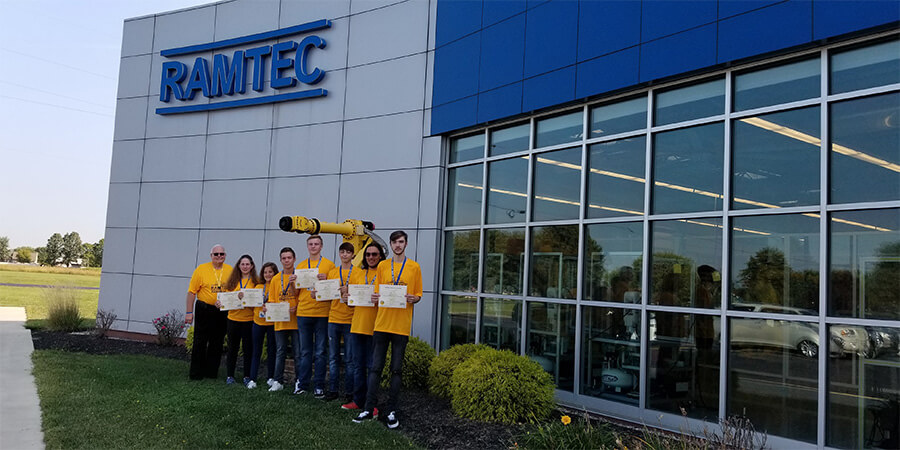
The NOCTI certification assessments make the CERT program robust and attracts schools like RAMTEC, located in Marion, Ohio. They have a number of classes for both students and adults, including a high school-level program that offers eight industry certifications. More than 274 students have become FANUC certified through RAMTEC.
“It’s a one stop shop for manufacturing training,” says Mark Edington, FANUC Certified Robotic Instructor at RAMTEC. “They can get training on all different platforms, including robotics, PLCs, hydraulics, industrial maintenance, electrical troubleshooting and others. We have all of that here.”
RAMTEC went through the NOCTI certification process, which enables students to earn an electronic badge showing their robotic certification and proves certified students have acquired industry-level knowledge. Edington worked for decades in manufacturing and understands what skills employees need to have now and in the future.
“If I would’ve seen something like what we are doing here at RAMTEC when I was in industry, I would have sent my people here,” he says. “Honda, Bridgestone, and well-over 100 other Tier 1 suppliers come to us knowing their people can become certified on many platforms.”
The students who receive CERT certifications can prove to potential employers, other educational institutions as well as the manufacturing industry at large that they have accumulated the critical skills necessary to do real-world jobs.
The school and its instructors work closely with industry leaders in the community to make sure their training programs are always up-to-date and align with what manufacturers need.
“We always stress to schools that the student is not your customer,” says Aiello. “They may pay you tuition, but really, the employer is your customer. The student is your product.”
Teaching Manufacturing Skills Helps Students Land Jobs
What FANUC America focuses on is the training of students and developing their technical skills that align to employers’ needs. In other words, if the employer is deploying technology powered by FANUC or Rockwell Automation, then those students need to learn on those platforms.
“That’s what gives those students a leg up in the workplace, so they can walk in the door and hit the ground running because they know and understand the technology,” says Aiello. “They can say, ‘I used that robot, that CNC machine, that process controller, I understand how to program, I understand the ladder logic and how they communicate.’”
Aiello explains that giving students these experiences is different from a student taking one robotics class and perhaps competing in a robotic competition.
“Those are great to develop an attraction in STEM careers, but they don’t translate well into occupational skills,” he says.
This is why FANUC America has developed relationships with technical schools across the country like RAMTEC.
“The key is training on real-world platforms,” says Edington. “When companies see the type of credentials our students get, like the iRVision certification, those students’ resumes are automatically put in the call-back file.”
FANUC America developed this type of partnership with educational institutions to help build pipeline solutions to the manufacturing workforce. Stay tuned next week to receive the 3rd edition of our 5 part series on developing manufacturing skills for the future.