

Challenges
Growing customer traceability requirements
Manual assembly limitations
Labor and technical resource constraints
Complex application series in small footprint
Results

Complete part traceability down to individual components

Automated quality verification—integrated leak testing, vision systems and inspection

Improved operational efficiency with focus on machine tending versus manual assembly

Scalable manufacturing platform—established a model for future growth
Story
When Atmus Filtration became an independent company in 2023, its leadership team saw an opportunity to rethink how automotive and industrial filtration products would be manufactured in the future. With evolving customer expectations and increasingly critical traceability requirements, the company recognized that traditional assembly methods were a limiting factor in its ability to scale.
As a supplier of filtration products for both automotive and industrial applications, Atmus serves customers that demand high quality, consistency and accountability. Like many manufacturers, the company had historically relied on manual assembly processes, where operators loaded and unloaded parts through standalone production cells. While effective, the approach created challenges when it came to tracking every component used in finished assembly.
For Atmus, the challenge extended beyond quality verification. Automotive customers increasingly require manufacturers to identify exactly which components were used in a particular product and determine whether any affected lots may be connected to field issues or recalls. Manually collecting that level of information across multiple assembly steps is difficult and time consuming.
To address the challenge, Atmus looked to longtime automation partner Big Sky Engineering. Having worked together for over 9 years, Atmus trusted the integrator's ability to deliver a sophisticated solution. During a visit to Big Sky's facility, Atmus saw traceability systems being deployed for medical manufacturing applications and recognized the same concepts could be applied to automotive filtration products.
The resulting system became Atmus' flagship automation cell.
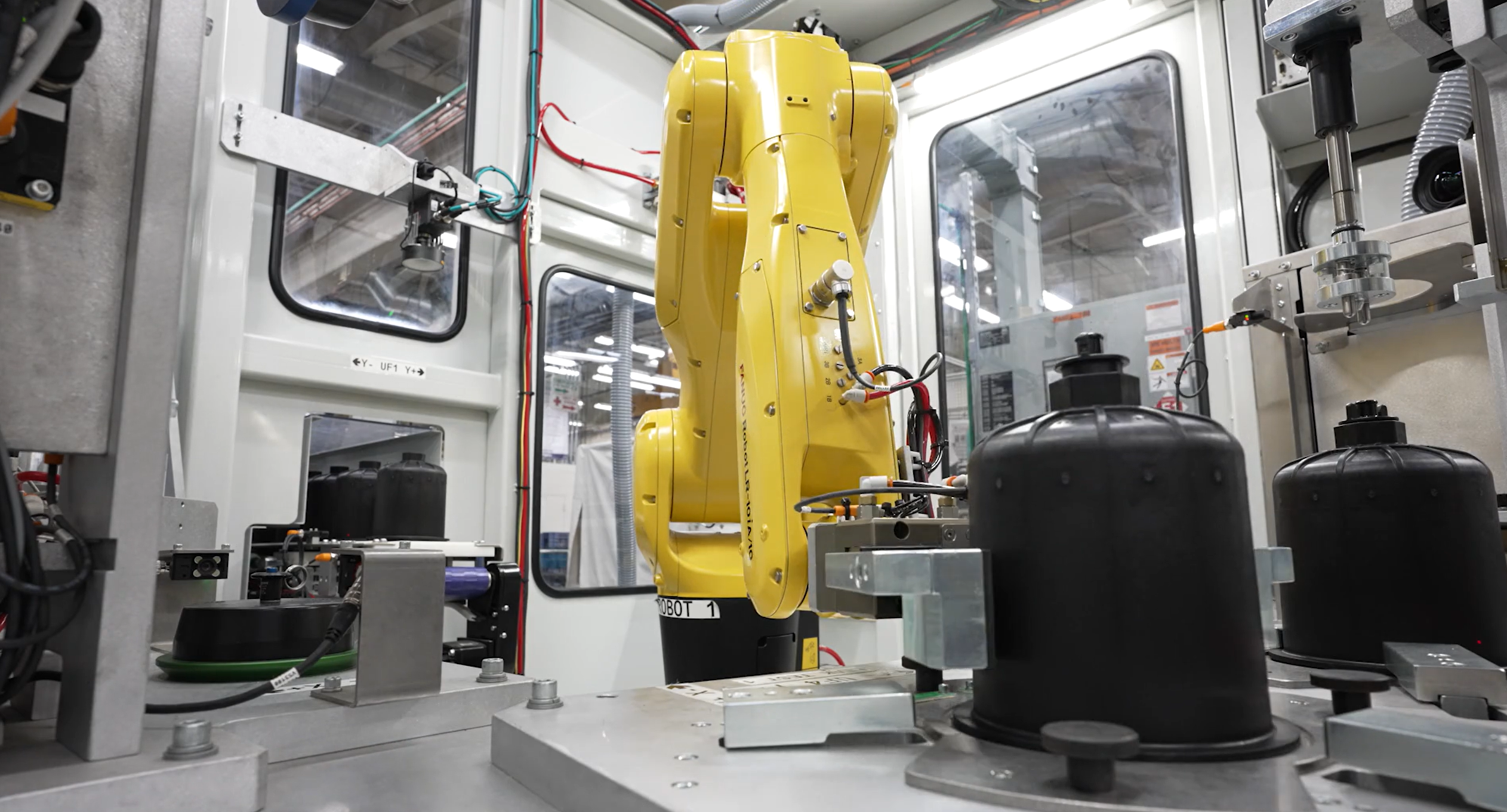
Designed and built by Big Sky Engineering, the new cell integrates multiple manufacturing operations into a single automated workflow. Components enter the cell and move through a series of processes that include O-ring installation, valve assembly, torque verification, leak testing, laser marking, filter insertion, bagging and final packaging. Throughout the process, traceability data is captured and maintained for every part.
Two FANUC LR-10iA/10 robots—which offer the reach, payload and flexibility needed to access multiple stations while maintaining a compact footprint—serve as a key element of the system. The automated cell also incorporates vision systems, scanning technology, leak testing and guided robotics, allowing numerous operations to occur within a single integrated platform.
Since launching, Atmus has realized benefits beyond traceability alone. Operators now focus on tending equipment and keeping materials supplied rather than performing repetitive manual assembly tasks. Automated quality checks help verify every critical process step, while production can continue through breaks without interrupting workflow.
Most importantly, the investment provides a blueprint for the company's future. What began as a solution to a traceability challenge has become a scalable manufacturing strategy that positions Atmus for continued growth.
As the company expands its filtration product offerings, Atmus expects future manufacturing investments to look much like the flagship cell operating today: automated, traceable and built to support the next generation of production demands.
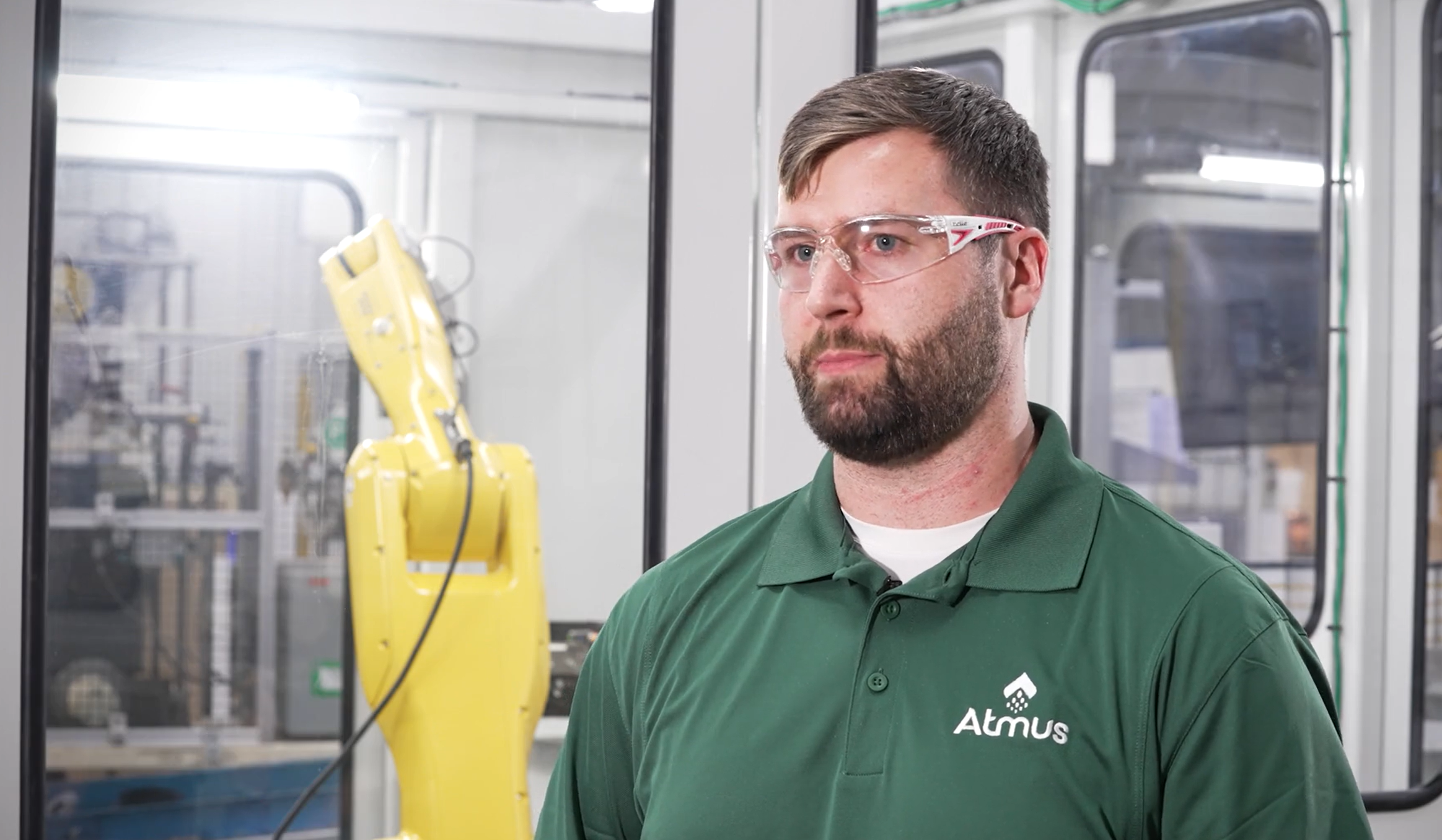
The future for Atmus looks a lot like this cell right here. We're looking at doing more fuel filters, more lube filters, and definitely looking at making investments just like this automation cell.
Eric Weltzien Senior Manufacturing Engineer of Plastics – Atmus FiltrationFANUC Products Used

LR-10iA/10
The FANUC LR-10iA/10 is a compact industrial robot with a 10 kg payload and long 1101 mm reach, ideal for flexible robotic material handling applications.
- Max Payload:
- 10 (up to 13) kg
- Reach:
- 1101 mm

Big Sky Engineering Inc.
Big Sky Engineering has designed and built custom automation since 1998. From our facility in Verona, Wisconsin, we deliver automated assembly equipment, robotic work cells, material handling and packaging systems, inspection systems, and closure lining and stacking machines for the medical and life sciences, food, consumer packaged goods, and industrial markets. Our medical and cleanroom work has made full part traceability, integrated inspection, and validated quality processes core capabilities, and we bring that same rigor to every industry we serve. FANUC is our standard robot platform, and our in-house mechanical, controls, and build teams take each project from concept through installation and support. If a standard machine won’t solve your problem, we build the one that will.
Atmus Filtration
Atmus Filtration Technologies Inc. is a global leader in filtration and media solutions. With more than 65 years of innovation and engineering expertise to deliver high-performance filtration solutions, Atmus operates through two business segments: Power Solutions, which serves global on- and off-highway equipment markets through its trusted Fleetguard® brand; and Industrial Solutions, which addresses commercial and industrial HVAC applications, and high- growth end markets including data centers and power generation environments – through its dependable Koch Filter® brand. Headquartered in Nashville, Tenn., Atmus employs nearly 5,000 people worldwide who are committed to creating a better future by protecting what is important.