R-1000 Series
The FANUC R-1000 Series delivers fast, compact performance for handling, welding, and palletizing with payloads up to 130 kg.
View R-1000 Series
View Product


Fabricators and manufacturers rely on a wide array of material joining methods to create the products, structures, machinery and transportation equipment used around the world. Robotic spot welding and riveting are go-to methods for bonding materials together due to spot welding robot's high repeatability, accuracy, throughput and overall profitability.
FANUC offers a wide variety of spot welding robots, process software and hardware solutions to help solve your material joining challenges. We are the industry leader in robotic spot welding and other robotic material joining applications with decades of experience and expertise. Trust FANUC with your next project requiring automated material joining and spot welding robot solutions.
FANUC spot welding robot series support a range of payload, reach and workcell requirements for automated material joining. Explore popular robot families used for high-speed spot welding, heavy-payload welding guns and compact spot welding workcells.
The FANUC R-1000 Series delivers fast, compact performance for handling, welding, and palletizing with payloads up to 130 kg.

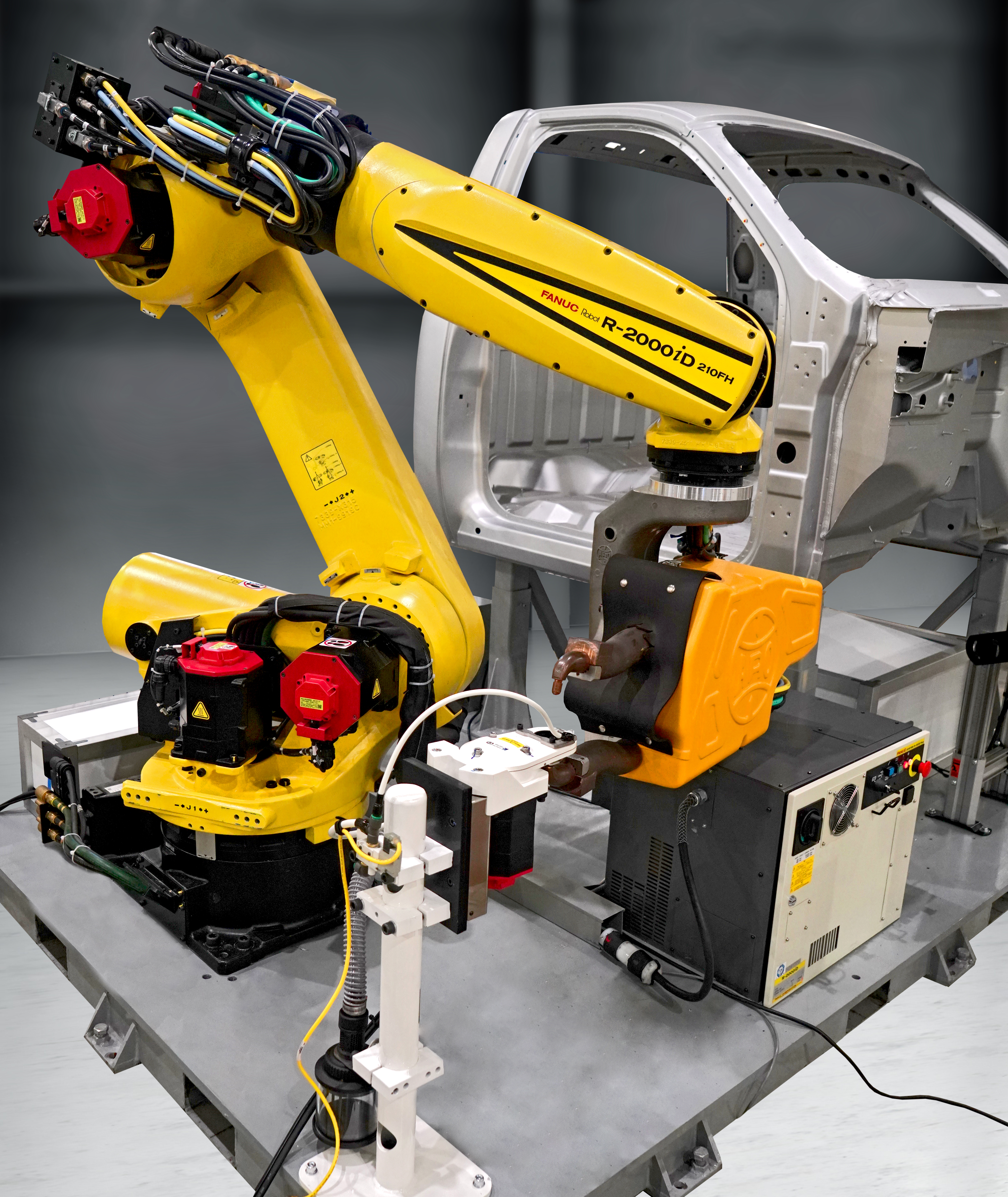
FANUC R-2000 robots handle 100–270 kg with high speed, compact design, and precision, making them ideal for heavy payload material handling and spot welding.

The FANUC M-900 Series handles heavy payloads up to 700 kg with long reach and versatile mounting for demanding applications.
Robotic spot welding helps manufacturers automate repetitive material joining tasks while improving weld consistency, throughput and process reliability. FANUC spot welding robots can support demanding production environments where uptime, repeatability and weld quality are critical.
Robots repeat programmed weld positions to help maintain consistent spot weld quality across production.
Automated spot welding systems can support faster cycle times and higher production volumes than many manual processes.
Robot motion helps reach weld locations that may be difficult, inconsistent or ergonomically challenging for manual operators.
Robotic spot welding can help reduce repetitive welding tasks and support a safer, more ergonomic workflow.
FANUC spot welding robots, SpotTool+ software and ZDT predictive maintenance can help support uptime and lifecycle performance.

The FANUC R-1000iA/120F-7B is a compact 7-axis robot designed to reach complex weld locations in tight workcells. Its seventh axis allows the robot to fold and shorten its second arm, helping it maneuver in narrow spaces while maintaining the payload and flexibility needed for robotic spot welding.
This added range of motion makes the R-1000iA/120F-7B well suited for automotive spot welding, compact material joining cells and applications where standard 6-axis robots may have limited access.
Watch FANUC spot welding robots in automotive, material joining and complex weld access applications. These videos show how robotic spot welding systems can improve repeatability, weld consistency and production efficiency.
FANUC R‑2000 robots perform spot welding as car bodies move down the line in a continuous automotive assembly system.
FANUC R‑2000 robots perform automated spot welding to join automotive body components with speed and repeatable accuracy.
Robotic spot welding systems join automotive parts with precise, repeatable welds using coordinated robot motion.
The Robo‑Rivet system uses FANUC robots to perform precise, repeatable blind fastening for complex structural and mixed‑material assemblies.
Video courtesy of ARM Automation
Find answers to common questions about robotic spot welding, FANUC spot welding robots, automated material joining and selecting the right robot for your application.
Robotic spot welding uses an industrial robot to automate spot welding or related material joining tasks. The robot positions the welding gun or joining tool at programmed locations to create repeatable welds with consistent accuracy.
Spot welding robots are commonly used to join automotive body components, sheet metal assemblies, structural parts and other manufactured products that require repeatable material joining.
Automated spot welding can improve weld consistency, repeatability, throughput, access to difficult welds and floor space efficiency compared with many manual joining processes.
The right spot welding robot depends on payload, reach, welding gun weight, part size, workcell layout, weld access, cycle time and production goals.
Popular FANUC robot series for spot welding include the R-1000 Series, R-2000 Series and M-900 Series, depending on payload, reach and application requirements.
Yes. FANUC Zero Down Time software can provide predictive maintenance notifications for FANUC spot welding systems to help improve uptime and reduce unplanned downtime.