CRX-30iA
The FANUC CRX-30iA is a heavy-lifting cobot with a 30kg payload, featuring wrist buttons for direct, simple teaching and customization.
View CRX-30iA
View Product


Automating palletizing can make your operations safer and more profitable. Whether you’re stacking a full layer or individual boxes, bags, pails or drums, FANUC’s palletizing cobots and robots offer a fast, steady, and reliable automated solution. Our extensive offerings provide many options in terms of size, payload, speeds for cycle time and precision and most importantly, care in handling your products.
To select the correct automated palletizing and depalletizing solution, consider payload, reach, duty, cycle time and floor space. Don’t forget the weight of your end of arm tool, dress out and product when selecting the desired payload range.
The FANUC CRX-30iA is a heavy-lifting cobot with a 30kg payload, featuring wrist buttons for direct, simple teaching and customization.

The CR-35iB cobot lifts up to 50kg with a compact footprint, advanced sensors, and easy programming—ideal for tight spaces and heavy-duty tasks.

The FANUC M‑710iC/50H is a compact, high‑speed robot ideal for fast handling, packing and palletizing applications where speed and efficiency matter.

The FANUC R-1000iA/80H robot is a versatile high-speed robot for a range of operations for medium size payloads including welding, handling and palletizing.

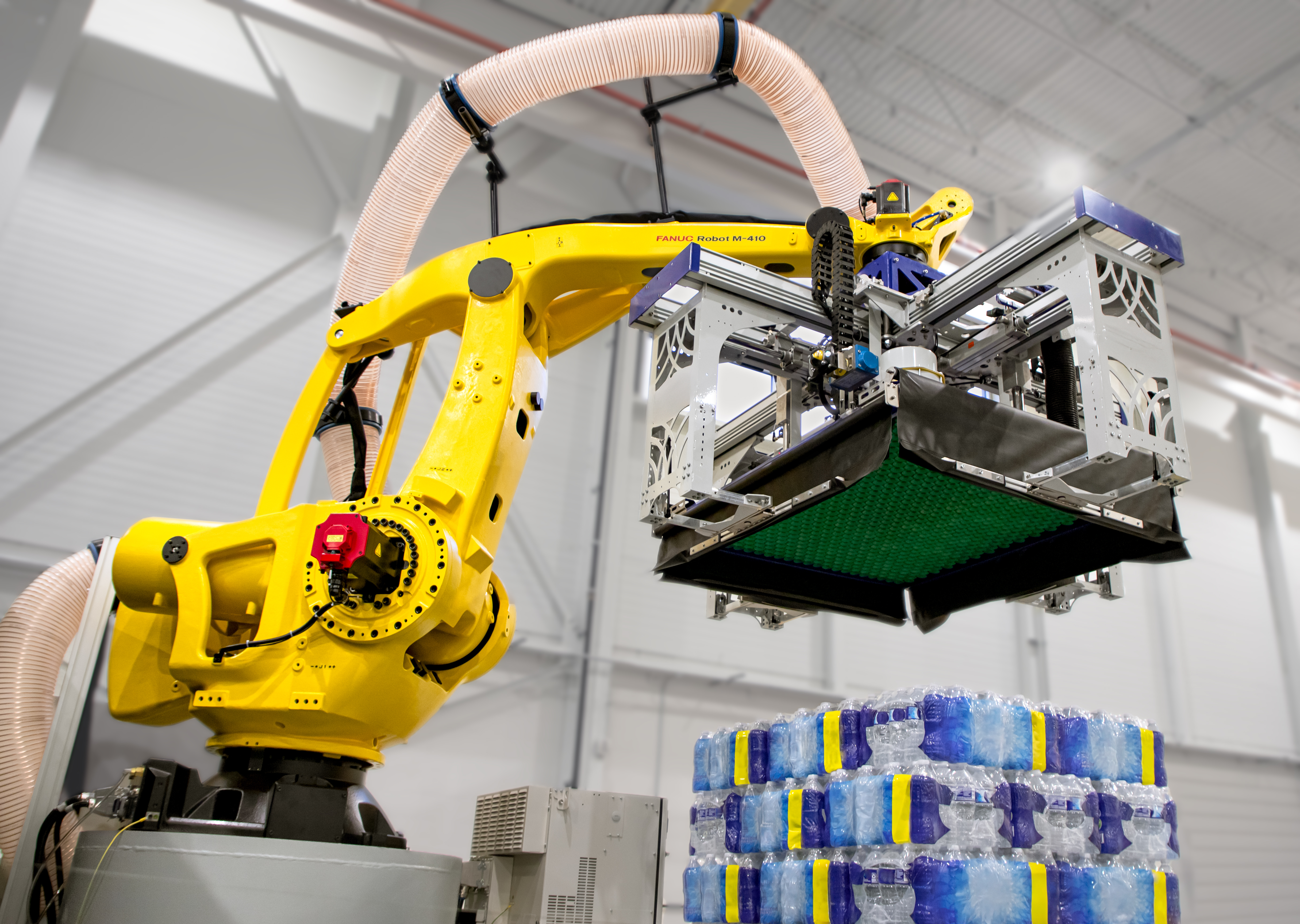
Boost palletizing throughput with FANUC M-410 robots—handling up to 800 kg with long reach and proven reliability for end-of-line automation.
Automated palletizing and depalletizing systems help manufacturers improve end-of-line efficiency, reduce manual handling and adapt to changing production demands. FANUC robots and cobots can support a wide range of payloads, pallet patterns, SKUs and container types while helping operations save space, increase throughput and improve consistency.
Palletizing cobots and robots offer a smaller footprint, saving you the cost per foot in a manufacturing facility. Plus, our solutions can be creatively and flexibly installed in tight spaces.
Versatile end of arm tooling can handle multiple types of containers at a time, regardless of their shape and/or material including cases, bags, pails, bottles, batteries, cubes of scrap metal, and plastic containers.
Cobot and robot palletizing solutions can easily accommodate different pallet patterns and product types. They have the ability to handle one or more units at a time and can form multiple layers on a pallet after picking the products off of a conveyor.
Palletizing cobots and robots can be programmed to handle multiple infeeds of different SKUs on the same line. Vision systems can be used to send information to the robot so it can pick and place different SKUs on different pallets.
Palletizing industrial robots can handle up to a 800kg payload. Depending on the type of robot and the application, an industrial palletizing robot can handle up to 30 cases per minute.

FANUC palletizing and depalletizing robots can handle a wide range of products, package types and pallet configurations. With the right robot, end-of-arm tooling and vision or line-tracking technology, automated systems can support consistent handling for single-SKU, mixed-SKU and high-volume end-of-line applications.
See how companies use FANUC robots, automation partners and AI-enabled systems to improve palletizing and depalletizing operations. These case studies show how robotic automation can help reduce manual handling, improve safety, increase throughput and support more consistent end-of-line performance.

AI-powered robotics transformed Lakeside Book’s depalletizing — beating human speeds, handling mixed-case variability, easing labor strain, and eliminating 45M+ lbs of lifting.


Facing DC congestion and labor-heavy depalletizing, GNC partnered with AWL to deploy FANUC R-2000 robots, smoothing product flow, improving consistency, and freeing employees for higher-value work.


Faced with surging product sales, the manufacturer of sustainable flexible packaging Polykar recognized that their existing operations couldn’t scale efficiently to meet growing customer demand. The solution was simple: automation. The goal was to integrate a robotic system that would guarantee employee satisfaction and retention while increasing output. Polykar enlisted FANUC Authorized System Integrator Vention to help them.

See FANUC robots and cobots in action across palletizing, depalletizing, case handling, bag palletizing, glass handling, pail and drum palletizing, and mixed-SKU workflows. These application videos show how robotic end-of-line automation can improve throughput, reduce manual handling, support flexible pallet patterns and handle a wide range of product types.
FANUC robotic palletizers help automate end-of-line pallet building with speed, flexibility and repeatability. These systems can handle multiple case sizes, SKUs, pallet patterns and line configurations while helping manufacturers improve productivity and reduce manual handling.
Koops Automation built a high speed FANUC palletizer handling 100 cases per minute supporting multiple SKUs and types with HMI driven changeovers.
Video courtesy of Koops Inc.
A FANUC M‑410iC/185 palletizes cases in flexible patterns, auto‑swaps pallets, and sends full loads to stretch wrapping for fast, continuous operation.

Video courtesy of RND Automation
A multi‑zone vacuum gripper palletizes pallets, slip sheets, and mixed boxes at 20/min, stacking directly on a stretch wrapper for stable, secure loads.
Video courtesy of Cross
Snack boxes merge to one conveyor and sort to nine picks, where three FANUC M‑410iC/185 robots palletize using multi‑zone tools and lift support.

Video courtesy of Conveyor & Automation Tech
The Hermes system uses a FANUC CRX‑30iA cobot to palletize products across two pallet positions within a compact, unfenced workcell.

Video courtesy of Zeta Group Engineering LLC
FANUC robots and cobots can automate case erecting, case transfer, palletizing and mixed-case handling. Robotic case handling systems help manufacturers manage different case sizes, reduce changeover complexity and improve end-of-line productivity.
An automated frozen‑food system uses multiple FANUC M-410iC/185 palletizing robots, conveyors, and pallet transfer equipment to sort and build pallets.

Video courtesy of Weldon Solutions
A FANUC robot tends multiple pallet positions to depalletize, cross‑dock, and rebuild mixed‑SKU pallets, with AMR handoff to stretch wrapping and labeling.

Video courtesy of Autotec Engineering
The RPL‑2000 Series uses a robotic palletizer to place pallets, slip sheets, and products, then conveys completed loads out of the cell automatically.

Video courtesy of Premier Tech
This palletizing solution uses a FANUC M‑410iC/185 robot and custom end‑of‑arm tooling to manage varied product cases and material handling tasks.

Video courtesy of Robex LLC (Acieta)
Three FANUC M‑410iC/185 palletizing robots stack meat cases from conveyors, manage slip sheets, and prepare pallets for freezer storage.

Video courtesy of Applied Manufacturing Technologies (AMT)
FANUC robotic depalletizing systems help automate the process of unloading pallets, cases, bags and mixed products. With vision, AI and specialized tooling, robots and cobots can handle variable product shapes, sizes and weights while improving efficiency and reducing manual lifting.
A FANUC R‑2000iC/165F robot uses 3D vision to depalletize raw material bags and feed them into a bag slitting machine for process tank loading.

Video courtesy of Southlake Automation Inc.
Two FANUC M‑410iB/140H robots depalletize 40‑lb cheese cases using vision, reorient them on a conveyor, and palletize finished loads.
Video courtesy of Zeta Group Engineering LLC
Robotic depalletizing uses vision and specialized tooling to remove cases, rows, or full layers and support mixed pallet workflows.

Video courtesy of Motion Controls Robotics Inc.
A FANUC M‑410iB/700 forms trays, loads bagged products, palletizes unit loads, and wraps stacked pallets in a fully integrated high‑volume system.

Video courtesy of Kaufman Engineered Systems Inc.
Three FANUC robots with R‑30iB controllers palletize 24‑count 12 oz slim cans at rates up to 100 cases per minute.
Video courtesy of Motion Controls Robotics Inc.
Six vision‑guided FANUC M‑710iC robots simultaneously remove beverage cases from pallets and transfer them to a mainline conveyor for mixed‑pack production.

Video courtesy of Strongpoint Automation
Automatic bag palletizer systems with FANUC robots can handle heavy, industrial-sized bags with ease. With the ability to handle multiple sizes and weights, robotic palletizers can gently and securely stack bags onto pallets. Transporting bags quickly out of your facility helps increase throughput and gives your operations a competitive advantage.
The APR‑1150 hybrid palletizing system uses a FANUC robot and elevator to orient, layer, and stack bagged products onto pallets.

Video courtesy of Premier Tech Systems and Automation
FANUC SCARA and palletizing robots handle liquid bags by loading trays, palletizing finished trays, and recirculating empty trays through the system.

Video courtesy of Simplimatic Automation Inc.
Bags are flattened, inspected, and conveyed to a FANUC M‑410iB robot that picks and palletizes them within an automated cell.
Video courtesy of Kaufman Engineered Systems Inc.
The FANUC M‑410iC/110 robot palletizes bags using iRVision for product detection and PalletTool for pallet pattern control.
A FANUC M‑410iC robot palletizes 50lb bags using fork‑style tooling, places slip sheets, and directs rejected bags to designated stations.

Video courtesy of Haver and Boecker USA
Automating palletizing of bulk glass products with FANUC robots can efficiently and gently handle this type of fragile material. Automating the palletizing of glass products with FANUC robots can reduce damage and minimize waste while driving down demand for physical labor and increasing productivity.
FANUC palletizing robots with specialized tooling build bottle layers and manage dunnage while pallets move via an automated transfer car.

Video courtesy of MSK Covertech
Multiple FANUC M‑410 robots palletize glass bottles, manage dunnage, and secure completed loads using an integrated strapping station.
Video courtesy of Kaufman Engineered Systems Inc.
FANUC robots palletizing pails can handle a wide variety of bulk products at significant speeds. Automating pail palletizing with FANUC robots maximizes flexibility and efficiency.
A FANUC M‑410iC robot with vacuum tooling palletizes heavy cases and pails, handling slip sheets and pallets within an automated cell.

Video courtesy of Brenton
A FANUC M‑410iC robot palletizes 55‑gallon drums and 5‑gallon pails with vision-based orientation and high payload handling.

Video courtesy of RLS Enterprises Inc.
FANUC robots are perfect for automating multi-product, multi-line palletizing systems such as handling rolls and cases. FANUC robots have the flexibility to palletize rolls and cases, minimizing product changeovers and boosting the productivity of operations.
A high‑speed palletizing system uses a FANUC M‑410 robot to palletize both rolls and finished cases from dual infeed conveyors using common end‑of‑arm tooling.
Video courtesy of Motion Controls Robotics Inc.
FANUC offers several software packages to help you automate your palletizing solution quickly and easily.
FANUC’s PalletTool® 3 allows operators to create and modify unit loads directly from the Tablet TP right on the floor. Users can simply input product dimensions and the software provides a list of possible pallet patterns as well as the space efficiency for each pattern. A Tablet TP is required to use PalletTool 3 with FANUC’s non-collaborative robots.
The PalletTool Turbo II package is designed to reduce the setup of robotic palletizing applications with a software bundle that includes PalletTool 4D. FANUC’s simulation software, PalletPRO, is also included in this package and allows for offline programming and creation of unit loads that can then be downloaded to the robot controller.
As a plugin to ROBOGUIDE, PalletPRO is a PC simulation software that allows users to build a complete palletizing work cell layout, including infeed and pallet stations, slip sheet and pallet dispensers. Hundreds of unit load pallet configurations can be created and visualized in 3D using PalletPRO’s built-in library of industry standard patterns. The data created in PalletPRO can be downloaded to a FANUC controller containing PalletTool software.

Examine how layer palletizing works, what constitutes an effective system, where it adds the most value, and why more facilities are making the switch.
Explore common questions about robotic palletizing, depalletizing, palletizing robots, collaborative palletizing systems and end-of-line automation. Learn how FANUC robots and cobots can help improve throughput, reduce manual handling and support flexible product handling.
Palletizing robots are automated robots used to stack, arrange and transfer products onto pallets. FANUC palletizing robots and cobots can handle boxes, bags, pails, drums, bottles, cases and other materials in end-of-line automation applications.
Robotic palletizing is the automated process of picking products from a conveyor, line or staging area and placing them onto a pallet in a defined pattern. FANUC robotic palletizing systems can support full-layer palletizing, individual case handling, mixed-SKU palletizing and high-speed production environments.
Palletizing is the process of stacking products onto a pallet. Depalletizing is the reverse process: unloading products from a pallet and transferring them to another location, such as a conveyor, fulfillment line or processing system. FANUC robots and cobots can support both palletizing and depalletizing applications.
FANUC palletizing robots can handle a wide variety of product types, including cases, boxes, bags, pails, bottles, drums, glass containers, rolls, batteries, plastic containers and mixed-SKU products. The right solution depends on the product weight, shape, material, pallet pattern and end-of-arm tooling.
To choose the right palletizing robot, consider payload, reach, duty cycle, cycle time, floor space and the total weight of the product, end-of-arm tool and dress out. FANUC offers palletizing cobots and industrial robots for a wide range of payload, speed and workspace requirements.
Yes. FANUC collaborative robots, including palletizing cobots such as the CRX-30iA and CR-35iB, can be used for palletizing applications where compact footprint, ease of programming and flexible installation are important. Cobots are especially useful for tight spaces and applications where collaborative operation is desired.
Yes. FANUC palletizing robots can be programmed to handle multiple infeeds and different SKUs on the same line. Vision systems can also be used to help robots identify, pick and place different SKUs onto the correct pallets.
Yes. FANUC palletizing robots are designed for end-of-line automation applications, including case palletizing, bag palletizing, bottle palletizing, pail and drum palletizing, robotic depalletizing, stretch-wrapper integration and automated pallet handling.