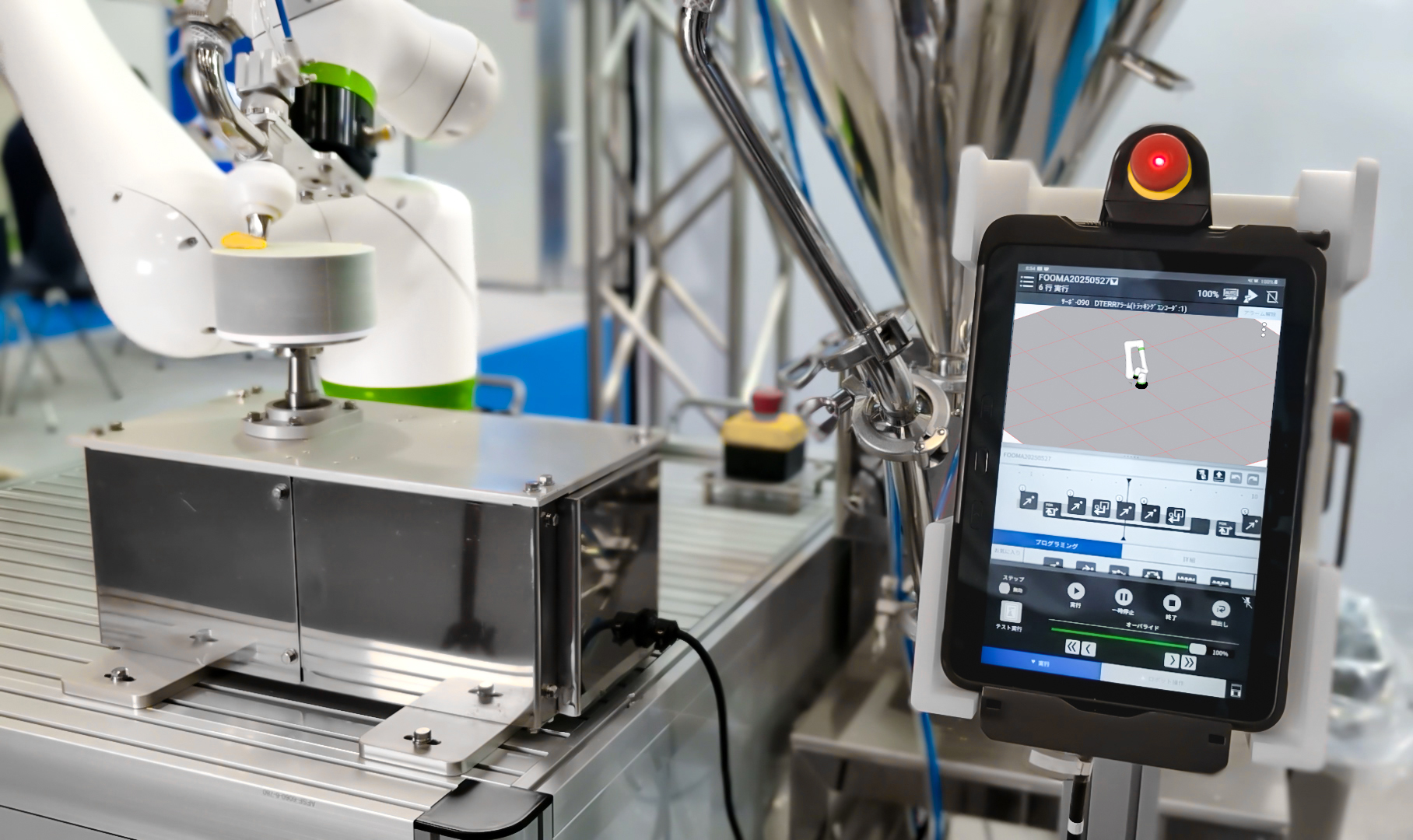
CRX Series Cobots
FANUC collaborative robots deliver safe, high‑precision automation with flexible payloads and easy integration for any production environment.
Improve quality, reduce waste, and increase productivity with FANUC robotic dispensing and sealing systems. Our industrial robots and collaborative robots (cobots) deliver the precision, accuracy, and repeatability required for demanding adhesive dispensing, glue application, epoxy dispensing, silicone dispensing, urethane application, and sealant dispensing processes.
From compact, high-speed robots designed for precision dispensing of adhesives and epoxies on small components to larger robots engineered for automotive seam sealing and other large-scale material application processes, FANUC provides proven automation solutions for a wide range of dispensing applications. Backed by the expertise of FANUC and our Authorized System Integrators (ASIs), manufacturers can implement reliable robotic dispensing systems that improve consistency, enhance product quality, and optimize material usage.
FANUC offers a wide variety of highly reliable dispensing and sealing robots that are dexterous, repeatable, compact and fast. Below is a selection to consider:
FANUC collaborative robots deliver safe, high‑precision automation with flexible payloads and easy integration for any production environment.
FANUCs LR Mate Series robots are your best compact robot solution for fast handling and processing parts up to 7 kg across a whole range of industries.
With a small footprint, the M-10 Series is the fastest-handling robot in its class, capable of handling small to medium-sized parts.
FANUC M-710 Series robots handle 12–70 kg with a slim wrist, fast speeds, and up to 3.1 m reach, delivering flexible, high-performance automation.
Robotic dispensing removes humans from working with potentially hazardous materials and environments. With FANUC cobots and robots automating the dispensing and sealing in operations, workers are freed up to do other tasks.
Robotic sealer applications apply a consistent material each and every time. Because the right amount of material is automatically dispensed by the robot or cobot, wasted product is reduced.
With automatic dispensing systems using robots and cobots, operations can handle greater volumes. With higher speeds and productivity enhancements, using automatic dispensing systems can increase throughput without adding extra labor or sacrificing quality.
FANUC robots and cobots are used for dispensing a wide variety of sealants, adhesives, oils and gasketing materials in a wide range of industries. Some examples include using robots for dispensing glue, urethane, epoxy or automotive seam sealer. FANUC robots are great for dispense applications, and our ASI Network can provide a tremendous amount of support with your application.
An LR Mate 200iD/7L robot performs gasket dispensing with smart part detection and precise Graco PCF control.
Video courtesy of Robotic Technical Support Services, Inc. (RTSS)
A FANUC‑powered Robotic Maintenance Vehicle scans and fills road cracks from a truck cab, boosting safety, speed, material control, and overall repair quality.
Video courtesy of Pioneer Industrial Systems LLC
Automated gasket dispensing cell using an LR Mate robot, smart part detection, and controlled Graco PCF dispensing.
Video courtesy of Robotic Technical Support Services, Inc. (RTSS)
A robotic sealing system with LR Mate 200iD, laser checks, and nest detection that ensures accurate silicone bead placement across multiple parts.
Video courtesy of Adaptec Solutions
From high-flow sealer applications to precision electronics dispensing, FANUC helps manufacturers automate complex material application processes while improving bead quality, reducing waste, and increasing production efficiency.
Automotive manufacturers use robotic dispensing systems throughout the production process for gasketing, structural bonding, seam sealing, and sound-deadening applications. FANUC robots are well suited for demanding automotive dispensing applications that require consistent bead placement, accurate path control, and reliable material flow.
Common automotive dispensing applications include:
FANUC robots can be selected based on the required payload, reach, dispense equipment configuration, and path complexity to support both compact and large-scale automotive dispensing systems.
Electric vehicle manufacturing creates new requirements for precise material dispensing, especially in battery and powertrain assembly. FANUC robots and cobots can help automate the application of materials used for sealing, bonding, insulating, and thermal management.
Common EV dispensing applications include:
For EV applications, dispense system configuration is especially important because material viscosity, bead size, flow rate changes, and dispense volume can directly affect quality and cycle time.
Robotic dispensing systems are also used across general manufacturing where consistent material application is critical to product quality and production efficiency. FANUC robots can support both carried dispense and pedestal dispense layouts depending on the part size, material delivery system, and application requirements.
Common general industry applications include:
These applications often benefit from careful robot selection based on reach, payload, acceleration, repeatability, and the mounting location of the dispense equipment.
Aerospace dispensing applications often involve high-value components, complex part geometries, and materials that require precise and repeatable application. FANUC robotic dispensing systems can help improve consistency while reducing the variability associated with manual material application.
Common aerospace dispensing applications include:
Because aerospace parts can be large, heavy, or geometrically complex, robot reach, payload capacity, and dispense hose management are important considerations when designing the automation system.
Electronics manufacturing requires precise control of small dispense volumes, bead size, and placement accuracy. FANUC compact robots and collaborative robots can support automated dispensing for electronics assembly where repeatability, controlled flow, and accurate nozzle positioning are essential.
Common electronics dispensing applications include:
Electronics applications may use specialized dispense nozzles such as needle tips, jetting valves, or small-orifice nozzles for precise material placement on compact components.
Want to take your dispensing operation to the next level? If so, try the FANUC Integrated Servo Dispensing software package. For this solution, FANUC provides a dispensing system with an integrated FANUC servo motor, allowing all dispense operations to be controlled from the robot controller, removing the need for additional control panels, and providing you with a more precise application. As part of this solution, FANUC offers a variety of applicators & temperature control devices to be your one-stop shop for sealing solutions.
Get answers to common questions about robotic dispensing systems, sealant application, robot selection, dispense equipment, software options, nozzle selection, and system layout considerations for automated material application.
Robotic dispensing is an automated process that uses industrial robots or collaborative robots to apply adhesives, sealants, RTV, silicone, urethane, epoxy, thermal interface materials, potting compounds, and other liquids with precision and repeatability. Robotic dispensing systems help manufacturers improve bead quality, reduce material waste, increase throughput, and create more consistent finished products.
FANUC robots and cobots can be used to dispense a wide range of materials, including adhesives, glue, epoxy, silicone, urethane, RTV, PVC sealer, LASD, thermal interface materials, potting compounds, foam-in-place gasket materials, and other sealants or liquids used in manufacturing applications.
Recommended FANUC robot series for dispensing applications include the R-2000 Series, R-1000 Series, M-710 Series, M-20 Series, and FANUC collaborative robots. Robot selection typically depends on payload, reach, acceleration, accuracy, repeatability, dispense equipment configuration, and whether the application uses carried dispense or pedestal dispense.
Dispense robots are primarily selected based on payload capacity and reach. Additional considerations include robot acceleration, repeatability, path accuracy, hose management, dispense equipment weight, part size, and required flow rate changes. For complex dispense paths, robot-mounted or pedestal-mounted metering equipment may help improve dispense response and bead consistency.
In a carried dispense layout, the robot carries the dispense valve over a fixtured part or conveyor-mounted part. This setup is useful for large or heavy parts and applications requiring multiple nozzles or complex bead paths. In a pedestal dispense layout, the dispense equipment is fixed and the robot carries the part under the dispense valve. Pedestal dispense can reduce hose movement and maintenance, especially when the part is lighter than the dispenser
The success of a robotic dispensing application depends on the dispense system design as much as the robot itself. Hose length, hose diameter, metering device capacity, dispense valve selection, nozzle type, material viscosity, and flow rate response all affect bead quality, repeatability, and cycle time. Incorrectly sized hoses or metering equipment can limit system performance and reduce dispense accuracy.
Positive displacement dispensing is generally recommended for automated robotic dispensing applications. This method uses a metering pump to control flow rate and dispense volume, helping improve consistency even when material viscosity changes. Time pressure dispensing is common in manual applications but can be less consistent because flow rate and dispensed volume may vary as material viscosity changes.
FANUC dispensing applications are supported by SpotTool+ with the Dispense Plug-in. The Dispense Plug-in provides a standard interface for dispensing hardware and materials, setup and I/O menus for dispense functions, high-priority outputs for repeatable valve on/off control, and global seal schedules for tuning dispense parameters such as TCP speed proportional flow control and valve timing.
Discover how FANUC’s Integrated Dispense redefines robotic adhesive application, delivering precise, stable, repeatable beads despite material variability.
Boost precision, ergonomics, and ROI with FANUC’s mobile automated dispensing cart powered by CRX-30iA and Graco technology.