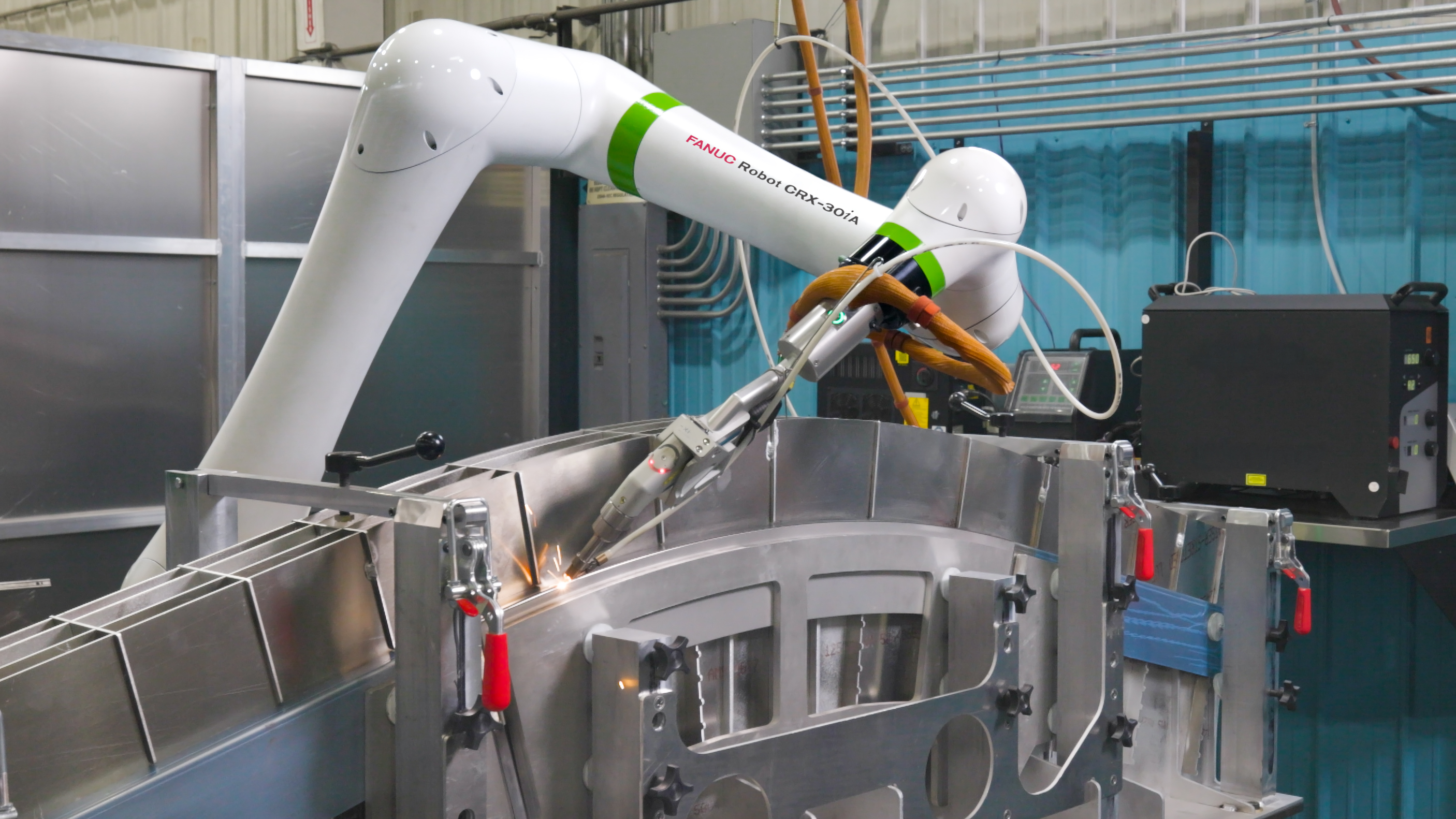
CRX-3iA Cobot
Ultra-lightweight collaborative robot weighing 11 kg with 692 mm reach, designed for fast, flexible welding, assembly, and installation in tight spaces.
FANUC welding cobots help manufacturers automate welding with easy programming, flexible deployment and reliable FANUC robot performance. With a range of collaborative robot models, FANUC can help you find a cobot welding solution that fits your payload, reach, workspace and production requirements.
Designed for ease of use, FANUC welding cobots make it possible to automate repetitive or difficult welding tasks, even for teams with limited robot experience. When properly applied with the required safety assessment, collaborative robots can work near people and help reduce the need for large, traditional robot guarding.
By working with FANUC and our Authorized System Integrator partners, manufacturers can develop cobot welding packages and collaborative welding systems for high-mix, low-volume production, changing part requirements and repeatable weld performance.
Explore FANUC collaborative robot models commonly used for cobot welding applications. The right model depends on payload, reach, weld process, tooling, part size and workcell requirements.
Ultra-lightweight collaborative robot weighing 11 kg with 692 mm reach, designed for fast, flexible welding, assembly, and installation in tight spaces.
Improve efficiency with the FANUC CRX-5iA cobot. Its 5kg payload, 994mm reach, and intuitive programming make it ideal for manufacturers.
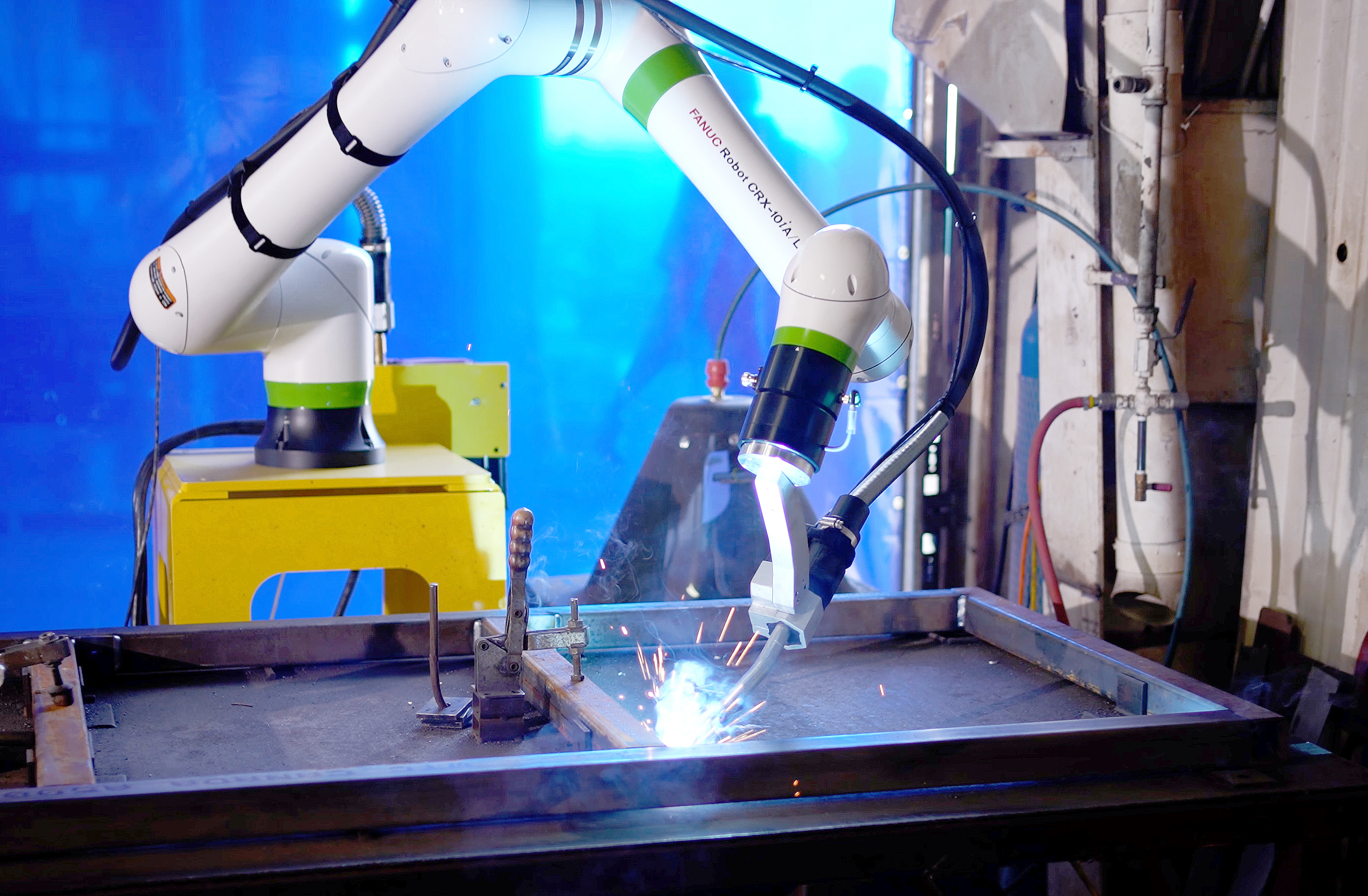
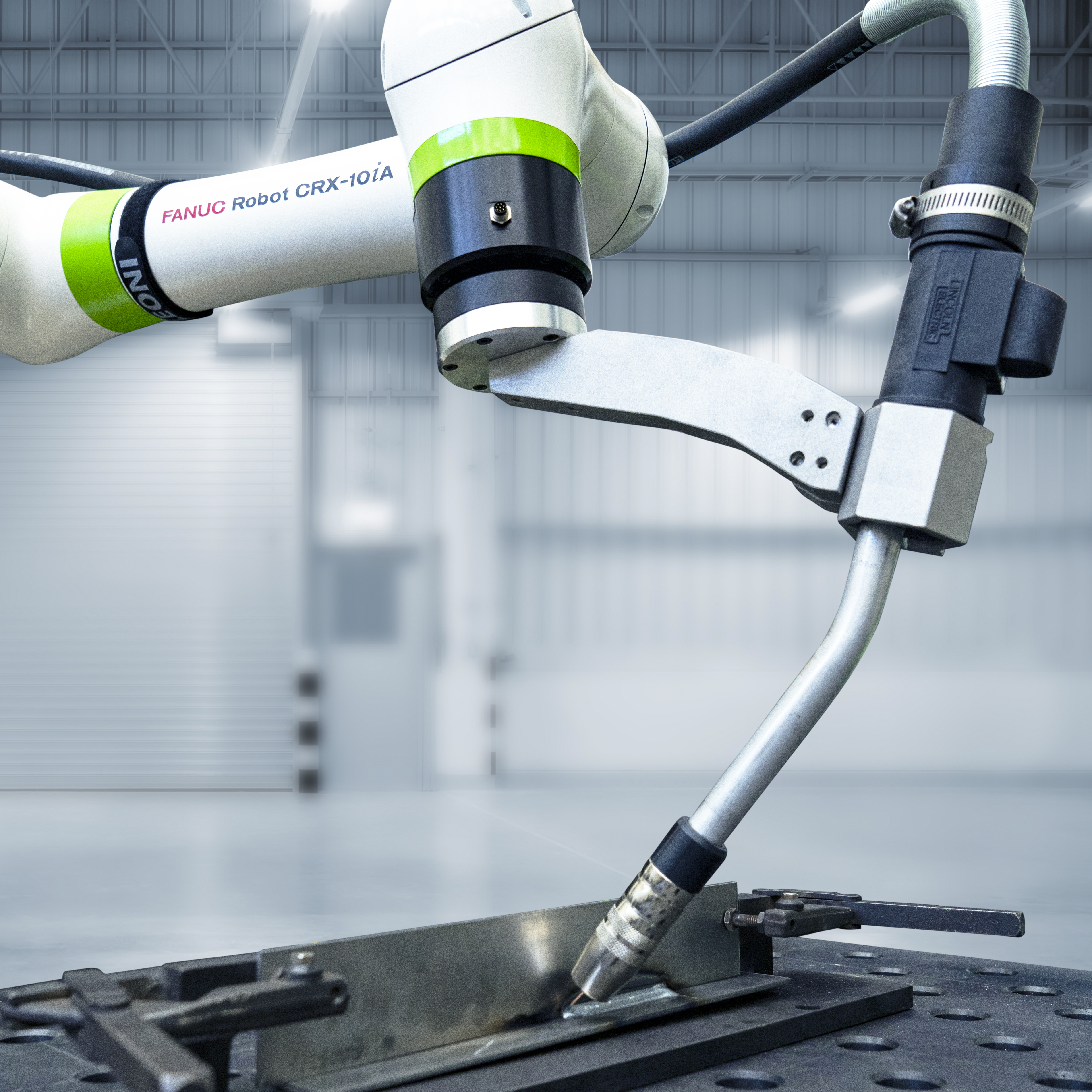
Enhance your overall production and revolutionize your workflow with the easy-to-program and reliable FANUC CRX-10iA cobot.
Boost productivity with the user-friendly FANUC CRX-10iA/L cobot featuring a 10kg payload, 1418mm reach, and simple programming.
CRX-20iA/L cobot offers 20kg payload, 1418mm reach, and underflip motion—ideal for high-payload tasks in compact industrial workspaces.
The FANUC CRX-30iA is a heavy-lifting cobot with a 30kg payload, featuring wrist buttons for direct, simple teaching and customization.
FANUC welding cobots are designed to help manufacturers get started with automation quickly. With intuitive programming, flexible mounting options and support for redeployment, cobot welding systems can adapt to changing jobs, part requirements and production layouts.
FANUC cobots can integrate with many weld packages, supporting torch, wire feeder and dresspack installation along with welding power source interfaces
FANUC programming tools use common welding terms to help teams create and adjust robot programs with minimal downtime.
Welding cobots can be moved or reconfigured for new jobs, work areas or part requirements, making them well suited for high-mix production.
FANUC welding cobots help manufacturers automate welding with easy programming, flexible redeployment and repeatable weld performance. They are well suited for shops that need to improve productivity, adapt to changing jobs and support skilled welders with collaborative automation.
FANUC welding cobots can use intelligent features and optional sensors to help improve weld consistency, locate parts, adjust to variation and support repeatable welding performance.
Options such as Touch Sensing, Thru-Arc Seam Tracking and laser vision can help locate seams, track joints and adjust to part variation.
FANUC iRVision helps robots recognize and locate parts, weld seams and part features, while supporting pre-weld checks and inspection tasks.
Tool Center Point adjustment during torch maintenance can help maintain consistent weld seams and support uptime.
Slim robot arms and wrists help welding cobots reach tight spaces while maintaining repeatable motion and weld quality.
FANUC ROBOGUIDE WeldPRO offline simulation software helps manufacturers develop and validate robotic welding workcells before installation. Users can import tooling and workpiece CAD models, simulate robot motion, evaluate reach and access, and define weld paths in a realistic 3D environment.
Programs and system settings developed offline can be transferred to the production robot, helping reduce on-site teaching time, improve path consistency and support a more predictable startup.
FANUC welding cobots are designed to make automation easier to set up, program and adapt to changing production needs. With intuitive teaching tools, welding software and intelligent options, FANUC helps manufacturers improve weld consistency while reducing programming time and deployment complexity.
Operators can teach weld points using hand guidance, lead-through programming and a tablet-style interface with drag-and-drop tools. FANUC CRX training resources also help teams learn setup, programming and operation so they can get started with cobot welding more quickly.
FANUC welding cobots support ARC Tool Software, an easy-to-use interface built around common welding terms. ARC Tool Software helps simplify programming while supporting advanced features such as Weaving, iRVision, Seam Tracking, TAST and Multi-pass.
For applications that require added reach or payload, FANUC CRX welding cobots can support heavier welding tools, sensors and peripheral equipment. Models such as the CRX-30iA provide expanded capacity while maintaining the ease of use and flexibility expected from a collaborative robot.
FANUC welding cobots are well suited for high-mix, low-volume production where part changeovers are common. Because cobots are easy to teach and redeploy, manufacturers can adapt to changing jobs while maintaining repeatable weld quality.
See how manufacturers use FANUC welding cobots to improve productivity, reduce repetitive manual welding, increase flexibility and support skilled welders with repeatable automation.
Using Lincoln Electric’s Cooper Cobot, Diamond Doors onshored hinge production, improved flexibility and customization, reduced repetitive labor, and upskilled operators.
To deliver three miles of bridge fencing, Seibel Modern unified operations with a FANUC CRX-10iA/L cobot — cutting touch-up work by 50% and accelerating production.
Pitts & Spitts scaled production with collaborative robotics, empowering workers, doubling wholesale reach, and expanding globally. Automation helped preserve craftsmanship while accelerating growth.
By adopting a FANUC CRX cobot with laser welding, Great Lakes Stainless reduced weld time from three hours to 15 minutes, delivering smoother finishes and major productivity gains.
Find answers to common questions about welding cobots, cobot welding packages, collaborative welding robots, programming, redeployment and common welding applications.
A welding cobot is a collaborative robot used to help automate welding tasks. FANUC welding cobots are designed for easy programming, flexible deployment and repeatable weld performance, making them useful for manufacturers that want to improve productivity while supporting skilled welders.
Welding cobots are used for repetitive welds, high-mix production, small-batch welding, part changeovers and applications where manufacturers need flexible automation. They can help improve consistency, reduce manual welding strain and allow skilled welders to focus on higher-value work.
According to ISO 10218 part 1 and part 2, there are four main types of collaborative robots: safety monitored stop, speed and separation, power and force limiting, and hand guiding.
The cost of a cobot welding system depends on the robot model, welding equipment, tooling, software, safety requirements, integration needs and application complexity. FANUC and its Authorized System Integrator network can help evaluate your welding requirements and recommend the right solution.
A cobot welding package typically includes a collaborative robot, welding equipment, software, torch, wire feeder, dressout and other components needed to automate welding. FANUC cobot welding packages can be configured to fit different production needs, part sizes, weld processes and workspace requirements.
Yes. FANUC welding cobots are designed for easy setup and programming. Operators can use intuitive programming tools, common welding terms and guided interfaces to create, adjust and redeploy programs for different welding jobs.
Yes. FANUC welding cobots can be moved or reconfigured for different parts, jobs and production areas. This makes cobot welding systems a strong fit for high-mix, low-volume production and shops with changing welding requirements.
Collaborative robots are designed with safety features that can allow them to work near people when properly applied. The final safety requirements for any cobot welding system depend on the application, tooling, workcell layout and required safety assessment.
A welding cobot is designed for collaborative applications, easier programming and flexible deployment, often in smaller or changing workspaces. An industrial welding robot is typically used for higher-speed, higher-volume or more heavily automated welding systems. The right choice depends on payload, reach, cycle time, safety requirements, part size and production goals.
The FANUC CRX‑10iA welding cobot performs collaborative arc welding with straightforward setup, intuitive programming, and reliable weld execution.
This promo highlights the FANUC CRX‑10iA collaborative welding robot, designed for easy deployment and repeatable welding in shared workspaces.