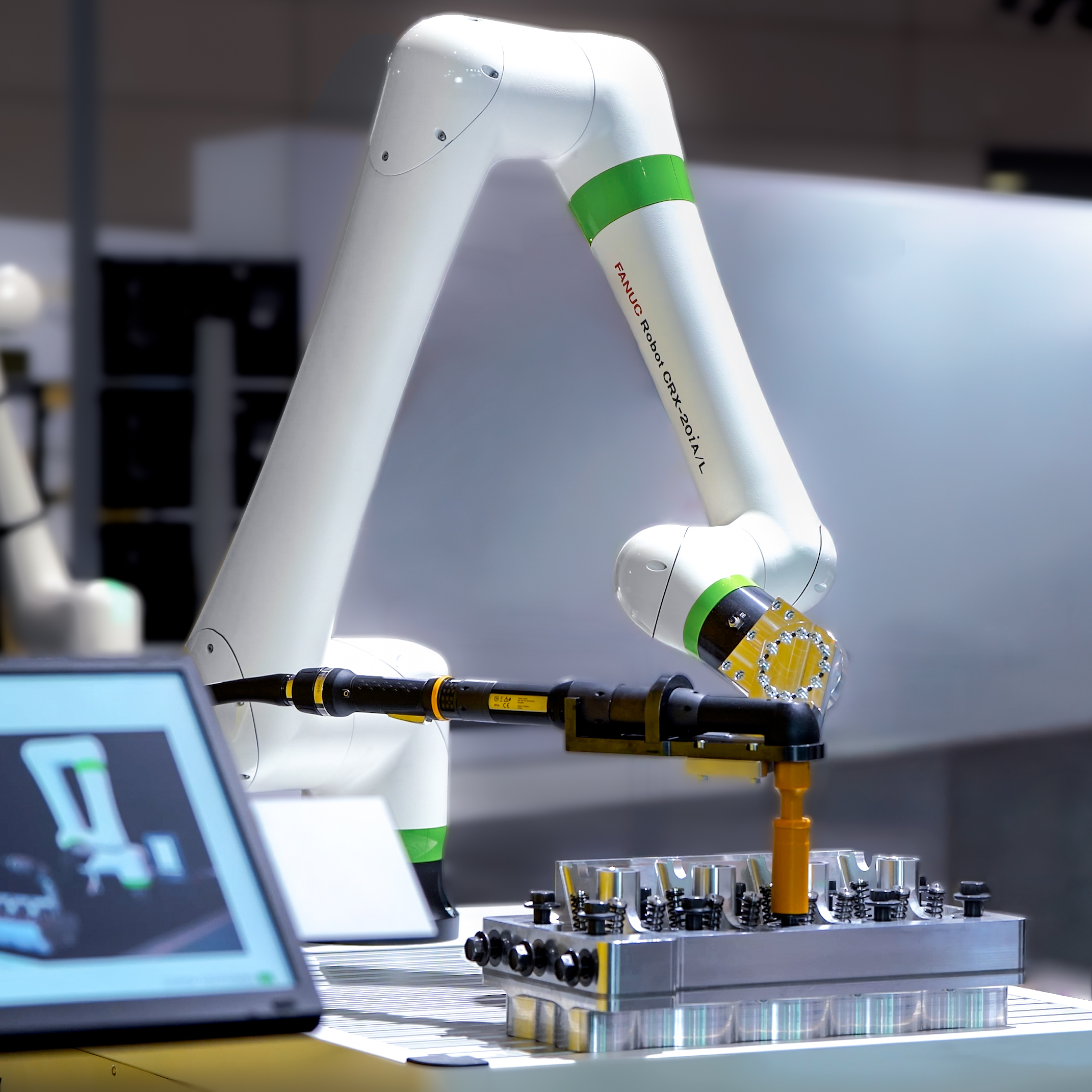
CRX Series
Ideal for collaborative screwdriving, part loading, and component placement.
View CRX Series
View Product


Robotic assembly is one of the most common applications for industrial robots. In automotive manufacturing, heavy-duty six-axis robots are widely used to increase capacity, improve quality, and support consistent production.
Today, assembly line robots are used far beyond automotive manufacturing. They help automate high-speed assembly of small, intricate parts across industries such as consumer goods, electronics, appliances, automotive components, and medical devices.
Assembly robots provide the speed and precision manufacturers need without sacrificing quality or accuracy. Their flexibility also helps manufacturers optimize workflow, increase capacity, and produce a wider range of products without relying on expensive fixed automation.
FANUC assembly robots can also be equipped with intelligent features such as integrated 2D and 3D iRVision and Force sensing to support more advanced assembly applications.
FANUC offers a wide range of robots for automated assembly applications, including SCARA, delta, collaborative, and articulated robots. These robots help manufacturers improve speed, precision, repeatability, and flexibility across a variety of assembly line processes.
Ideal for collaborative screwdriving, part loading, and component placement.

Engineered for high-speed press fitting, insertion, screwdriving, and component assembly.

Designed for rapid picking, orienting, and assembly of lightweight miniature components.

Optimized for conveyor tracking, component feeding, part orientation, and high-speed assembly.

Supports multi-part picking, larger end-of-arm tooling, and high-throughput assembly processes.

Ideal for intricate assembly and fastening.

Handles assembly components, tooling, and materials across flexible multi-process workcells.

Supports higher-payload handling, fastening, insertion, and multi-stage assembly operations.
Manual assembly can be physically demanding and time-consuming, especially when tasks involve repetitive motion, heavy parts, or precise placement. FANUC assembly robots help manufacturers automate these processes while improving consistency, quality, and production efficiency.
FANUC assembly line robots ensure high reliability, repeatability, and uptime, optimizing performance and consistency. They also contribute to labor savings and improved ergonomics, reducing strain on workers while enhancing efficiency. Additionally, by minimizing errors and defects, assembly line robots significantly reduces scrap costs, leading to greater overall cost-effectiveness.
Assembly robots can be adapted for different products, part types, and production requirements. Tool changers, stored programs, and vision-guided capabilities make it easier to support changeovers and adjust to shifting manufacturing needs.
Robotic assembly helps reduce handling errors, part damage, and process variation. Integrated vision systems can also support inspection tasks, helping manufacturers maintain consistent quality throughout production.
Vision-guided robots, force sensing, and repeatable robot motion help support accurate part placement, fastening, insertion, and assembly. This level of precision is especially valuable for small parts, intricate components, and high-volume production.

Assembly line robots are used across many industries where speed, accuracy, and consistency are important. FANUC robots can support both high-volume assembly lines and flexible production environments with frequent product changeovers.

FANUC assembly robots can support a wide range of automated assembly processes, including:
These examples show how FANUC robots can automate common assembly tasks such as fastening, rivet insertion, part handling, solder paste application, spring loading, and inspection. Robotic assembly systems can be configured for both high-volume production and flexible manufacturing environments.
Two FANUC M‑710iC/45M robots flip, orient, and move rails while six SCARA-6iA robots insert up to 120 rivets per part, delivering fast, automated rail assembly.

Video courtesy of Matrix Design
A FANUC LR Mate 200iD assembles parts by placing covers, applying solder paste, heating, loading springs, and unloading finished units for inspection.

Video courtesy of Paramount Tool Company Inc.
Two FANUC M‑20iD/35 robots auto‑drive screws and inserts into CNC‑cut wood parts using tool changers and blow‑feed drivers for fast, consistent fastening.

Video courtesy of Remtec
A FANUC LR Mate 10iA/10 automates ultrasonic sensor assembly, delivering 160 units per shift with flexible recipes and multi‑orientation pick‑and‑place.

Video courtesy of Concept Systems Inc.
Automotive assembly often requires speed, precision, repeatability, and reliable quality control. FANUC robots can support a variety of automotive assembly applications, including connector assembly, screwdriving, material handling, inspection, leak testing, and multi-robot production systems.
FANUC SCARA robots drive high-speed, flexible connector assembly with automated changeover, in-line inspection, and scalable automotive production.

Video courtesy of MS Automation
FANUC M‑710iC/70 and R-2000iC/270F robots assemble automotive grilles using adaptive nesting, precision screw driving, and vision‑based end‑of‑line testing.

Video courtesy of HA Industries Inc.

Video courtesy of Integrion Automation
FANUC SR‑3iA, SR‑6iA, and an LR Mate feed, place, screwdrive, and grommet‑insert parts on a rotary dial, automatically sorting finished assemblies.

Video courtesy of RND Automation
FANUC robots perform vision inspection, sealing, baffle and sensor installation, leak testing, and bolt fastening on aluminum engine covers.

Video courtesy of TranTek Automation Corporation
FANUC M-3iA/6A Delta robot assembles a fan.
Consumer electronics assembly often involves small parts, tight tolerances, and high-speed production requirements. FANUC robots can help automate precise part placement, handling, inspection, and assembly processes for compact electronic components.
5 stages of FANUC M-1iA/0.5AL Delta robots assemble water meters.
Battery assembly requires consistent handling, accurate placement, and repeatable production processes. FANUC robots can support battery pack assembly and related operations where precision, reliability, and production efficiency are critical.
A FANUC SR-3iA SCARA robot assembles battery packs.
Robotic assembly can help manufacturers automate appliance components, kitting, testing, packing, and other repetitive production tasks. FANUC robots provide the flexibility to handle different part types while maintaining speed and consistency.
Multiple FANUC M-10iA/12S assemble exterior door handles.

Video courtesy of Mission Design & Automation LLC
High-speed automated system using FANUC robots, vision, forming, testing, and laser marking to deliver consistent, high-quality parts.
Video courtesy of RND Automation
Video courtesy of Remtec
Vision‑guided FANUC robots handle inserts, coins, covers, and inspections to automate complete proof coin set assembly.

Video courtesy of Farason Corporation
Assembly line robots are industrial robots used to automate assembly tasks such as part placement, fastening, insertion, inspection, testing, and handling. They help manufacturers improve speed, repeatability, and quality across automated production lines.
Common robots used for assembly include SCARA robots, delta robots, collaborative robots, and six-axis articulated robots. The best choice depends on the application, payload, reach, speed, available floor space, and level of precision required.
Assembly robots improve production by increasing throughput, reducing repetitive manual work, improving consistency, and minimizing errors. They can also help manufacturers adapt to changing product designs or production volumes.
Yes. Robots are well suited for small-part assembly, especially when applications require high speed, precision, and repeatability. SCARA, delta, and compact articulated robots are often used for small components and intricate assembly processes.
Choosing the right assembly robot depends on the part size, payload, reach, cycle time, precision requirements, available workspace, and whether the process requires vision, force sensing, or end-of-arm tooling. FANUC application experts can help evaluate the best robot for your assembly process.
Robotic assembly is used in automotive, electronics, appliances, medical devices, battery production, consumer goods, aerospace, and industrial equipment manufacturing. Robots can support both high-volume production and flexible assembly operations.