Arc
Arc Welding Robots
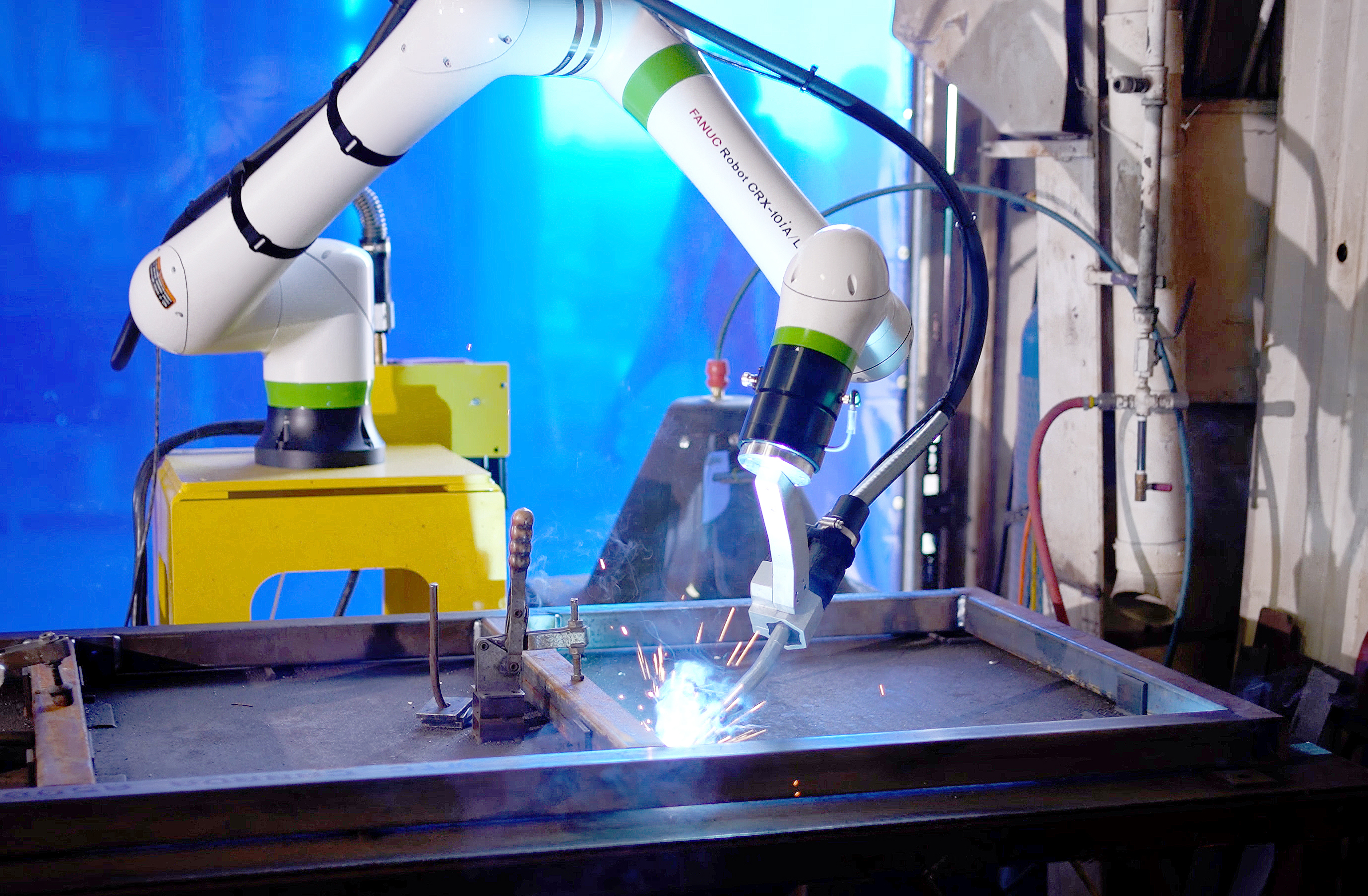
FANUC arc welding robots support automated MIG, TIG, plasma and other arc welding applications with high repeatability, coordinated motion and welding-specific software.
Explore Arc Welding Robots


Manufacturers use robotic welding systems to improve weld consistency, repeatability, throughput and floor space efficiency while reducing reliance on repetitive manual welding tasks. FANUC offers welding robots, cobots, software and automation expertise to support a wide range of joining processes and production requirements.
Different welding applications require different robot types, tooling, software and workcell designs. Explore FANUC welding solutions by process to find the best fit for your production needs.
FANUC arc welding robots support automated MIG, TIG, plasma and other arc welding applications with high repeatability, coordinated motion and welding-specific software.
Explore Arc Welding Robots
FANUC spot welding robots help manufacturers automate resistance spot welding and material joining with repeatable weld quality, high throughput and flexible robot motion.
Explore Spot Welding Robots
FANUC welding cobots support collaborative welding applications that require easy programming, flexible redeployment and compact automation for changing production needs.
Explore Welding Cobots
FANUC robots can support laser welding and laser processing applications that require precision, repeatability and advanced motion control.
Explore Laser Applications
Friction stir welding is a solid-state joining process that uses controlled tool motion, force and rotation to join materials without melting them. FANUC automation can support friction stir welding systems that require precise motion control, repeatable path execution and process monitoring for large or complex parts.
Robotic welding automation helps manufacturers improve weld consistency, increase throughput and adapt to changing production needs. FANUC welding robots and cobots can support a wide range of welding processes, part sizes and production environments.
Robots follow programmed paths and process parameters to help produce repeatable weld quality across production.
Automated welding systems can help increase throughput and reduce bottlenecks in manual or labor-constrained welding operations.
Robots can reach challenging weld locations with repeatable motion, helping improve consistency on complex parts and assemblies.
FANUC welding robots can support arc, spot, laser, MIG, TIG and advanced joining applications depending on tooling and system configuration.
Robotic welding can help reduce repetitive welding tasks and allow skilled welders to focus on higher-value work.

FANUC welding robots and cobots support automated welding and material joining across a wide range of industries. From automotive production and fabricated metals to aerospace, electric vehicles and general manufacturing, robotic welding can help improve weld consistency, throughput and production flexibility.
See how manufacturers use FANUC robotic welding systems to improve throughput, reduce rework, support labor challenges and modernize production across different welding applications.

To overcome skilled welder shortages, Steelway Building Systems adopted robotic beam welding — boosting throughput, redeploying labor, and positioning the operation for scalable growth.


Trantech partnered with WeldBot to replace outdated brazing with FANUC ARC Mate robotics, raising throughput 30%, cutting rework up to 80%, and modernizing radiator manufacturing operations.


Partnering with Quickmill, CTC built a FANUC-driven friction stir welding machine that welds large, thick steel plates in one pass while adjusting in real time and capturing key data.


By adopting a FANUC CRX cobot with laser welding, Great Lakes Stainless reduced weld time from three hours to 15 minutes, delivering smoother finishes and major productivity gains.

Watch FANUC robots and cobots in welding applications, including arc welding, collaborative welding, laser welding, friction stir welding and fabricated metal production.
A live welding demonstration featuring a FANUC CRX-10iA/L cobot performing collaborative arc welding operations.
A FANUC M-20iD robot guides a high-definition plasma system to cut structural steel profiles within an automated CNC fabrication cell.
This promo highlights the FANUC CRX-10iA collaborative welding robot, designed for easy deployment and repeatable welding in shared workspaces.
An ARC Mate 100iD robot performs arc welding as a single-axis positioner rotates the part for optimal weld access.
A FANUC CRX-10iA cobot is manually taught weld paths and performs collaborative arc welding with intuitive hand-guidance programming.
This system pairs a FANUC Arc Mate robot with a servo-controlled track and two-axis positioner to weld rotating parts using push-pull wire feeding.

Video courtesy of Weldbot
With the FastARC PW system, ports are welded quickly, with high-quality and accurate welds.

Video courtesy of Acieta LLC
Laserax battery laser welding machine automates welding of busbars to cells for battery modules and packs.

Video courtesy of Laserax

Ohio’s Last Arrow Manufacturing increased productivity using CRX welding cobots, resulting in business growth, employee satisfaction, and higher profits.

Learn how to take advantage of Industry 4.0 and the Industrial Internet of Things to help maximize your robotic welding productivity.
Find answers to common questions about welding robots, robotic welding systems, welding automation, cobots, process selection and advanced joining applications.
Welding robots are industrial robots or collaborative robots used to automate welding and material joining tasks. They can help improve weld consistency, repeatability, throughput and access to difficult weld locations.
Robots can support many welding and joining processes, including arc welding, spot welding, MIG welding, TIG welding, laser welding, plasma applications and friction stir welding, depending on tooling and system configuration.
Arc welding robots automate processes such as MIG and TIG welding using a welding torch and arc. Spot welding robots typically automate resistance spot welding or material joining by positioning a welding gun or joining tool at programmed locations.
A welding cobot is useful when an application requires easier programming, flexible redeployment or compact automation for changing production needs. For high-volume or more complex industrial systems, a traditional industrial welding robot may be a better fit.
Yes. FANUC robots can support laser welding and laser processing applications that require precision motion, repeatability and integration with laser equipment.
Friction stir welding is a solid-state joining process that uses a rotating tool, force and controlled motion to join materials without melting them. FANUC automation can support friction stir welding systems that require precise motion and process control.
The right welding robot depends on the welding process, payload, reach, part size, tooling, workcell layout, cycle time and production goals. FANUC and its Authorized System Integrators can help evaluate the best solution for your application.