ROS 2 Support
FANUC ROS 2 Driver
Connect FANUC CRX collaborative robots to ROS 2 with the official FANUC driver. Enable advanced automation, MoveIt integration, simulation, and real-time robot control.


Connect FANUC CRX collaborative robots to ROS 2 with the official FANUC driver. Enable advanced automation, MoveIt integration, simulation, and real-time robot control.

FANUC’s robot controllers can now execute Python programs directly, without the need for a PC. This enables robot control using AI developed with Python, a language widely used in AI development.
Control robot position, speed, and torque in real time with Stream Motion. Industry-leading 1 ms communication enables high-speed trajectory execution and advanced automation.
FANUC is advancing the real-world adoption of physical AI by building strong, strategic partnerships with leading global technology innovators that will drive industrial automation worldwide. Focused on a future where AI solves real-world challenges through physical action, FANUC continues to drive progress and shape transformation. See how FANUC’s work with NVIDIA and Google are advancing this goal, below.

See how FANUC and NVIDIA are advancing Physical AI with real-time simulation, imitation learning, digital twins, and next-generation AI hardware for industrial robots.

Discover how FANUC and Google are using generative AI, Gemini, and advanced robotics software to make robot programming more intuitive, flexible, and accessible.

The FANUC ROS 2 driver is available now for the CRX Collaborative Robot Series and several other models. Developers can access documentation, installation guides, and support via FANUC CORPORATION’s official GitHub repositories.

One of the greatest advantages of an open platform is the flexibility to use computing resources from both cloud data centers and edge servers, all connected via next-generation high-speed communication. This means manufacturers can scale automation, optimize performance, and adapt quickly to changing production needs.
Physical AI helps manufacturers move beyond traditional robot programming by combining robotics, artificial intelligence, real-time control, simulation, and open development platforms. With FANUC’s support for ROS 2, Python programming, Stream Motion, digital twins, and strategic AI partnerships, manufacturers can build more flexible, intelligent, and adaptive automation systems.
Physical AI makes robot programming more intuitive by allowing developers and operators to use tools such as Python, ROS 2, generative AI, and natural language instructions. Instead of relying only on traditional robot programming methods, teams can create automation workflows that are easier to modify, scale, and adapt.
FANUC’s open platform initiatives help developers connect industrial robots with modern automation tools, simulation environments, AI models, and edge or cloud computing resources. This allows manufacturers to test new ideas faster, integrate third-party technologies, and accelerate deployment of advanced robotics applications.
Physical AI helps robots respond to changing conditions with greater precision. With FANUC Stream Motion, robots can adjust position, speed, and torque in real time to support AI-guided tracking, adaptive movement, and high-speed trajectory execution.
AI-driven perception and real-time path adjustment can help robots operate more intelligently around people and equipment. By detecting nearby workers and modifying motion in real time, Physical AI supports safer and more efficient collaborative automation environments.
Digital twins and advanced simulation allow manufacturers to design, test, and validate robot systems before deployment. Teams can evaluate layouts, analyze cycle times, train AI models, and optimize robot motion virtually, helping reduce risk and shorten commissioning timelines.
Because Physical AI relies on open, connected platforms, manufacturers can scale automation across different cells, lines, facilities, and use cases. By combining edge computing, cloud resources, AI models, and industrial robotics, companies can build automation strategies that evolve with production needs.

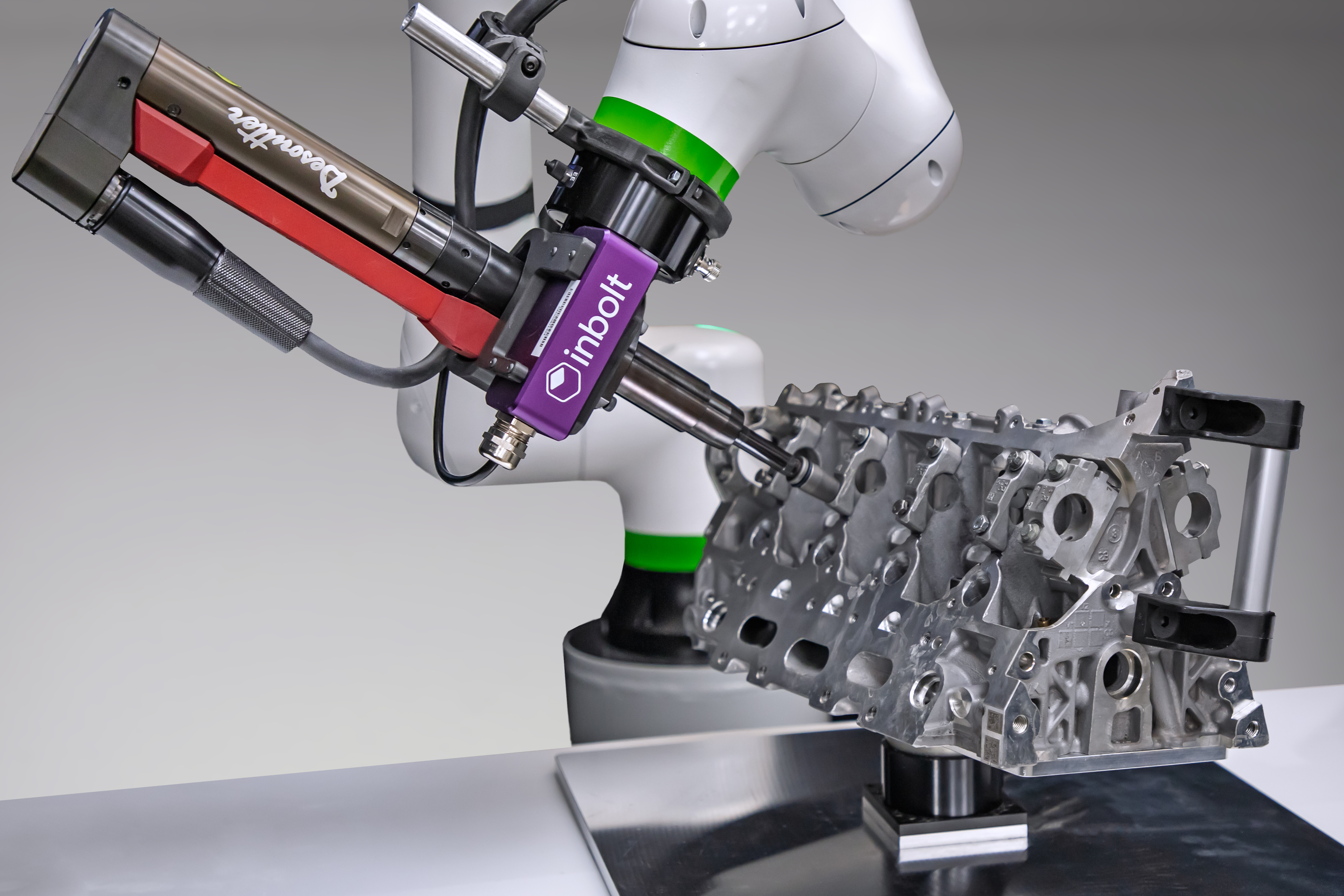
FANUC robots can identify and track workpieces moving in three dimensions, following them precisely in real time. This enables operations such as tightening screws on moving parts, a task that traditionally required precise fixturing or part stabilization. With 1 millisecond high‑speed tracking performance, high-speed 3D tracking ensures consistent accuracy even in dynamic environments.

By issuing instructions in natural language to the AI agent for tasks like photographing order forms, recognizing text, and transporting trays and parts, a robot can execute the kitting of workpieces. By combining an AI agent—which understands natural language to control the robot and autonomously execute tasks—with a masterless AI recognition function that identifies objects based on natural language inputs, it becomes possible to modify operation logic, just as if instructing a human.

FANUC robots equipped with AI-driven perception can detect nearby people and adjust their paths in real time without stopping production. If a human enters the robot’s working area, the robot automatically modifies its trajectory to avoid contact. Once the area is clear, the robot returns to its original path and continues the task. This enables safe, uninterrupted collaboration on the factory floor.

Two FANUC robot arms can work together to perform highly dexterous wiring operations. The system detects cable tension in real time and manipulates soft, flexible cables with human-like sensitivity. Leveraging multi-axis articulation, the robots route cables across complex 3D paths—including height, depth, and tilt—while maintaining accurate handling and preventing damage.

FANUC robots can recognize voice commands in multiple languages, automatically generate Python programs using generative AI, and execute the resulting tasks while perceiving their surroundings. Users provide instructions verbally, and the robot interprets the language, generates the appropriate program and carries out the requested action.
These capabilities also support complex tasks such as:
These tasks previously required specialized programming but can now be executed through intuitive voice commands.

FANUC es compatible con tecnologías avanzadas de simulación y gemelos digitales que permiten a los fabricantes diseñar, probar y validar sistemas robóticos antes de su implementación. Los entornos de fábrica virtual fotorrealistas ayudan a los equipos a modelar el comportamiento de los robots, evaluar la disposición de las celdas y optimizar el rendimiento en un entorno sin riesgos. Los robots de FANUC están disponibles en formatos adecuados para las plataformas de simulación modernas, lo que permite el análisis del tiempo de ciclo, la validación de trayectorias y la generación de datos de entrenamiento de IA en flujos de trabajo de producción virtual. Estas herramientas acortan el tiempo de puesta en marcha y mejoran la precisión general del sistema.

El ecosistema de simulación de FANUC —como sus herramientas de programación fuera de línea— admite el intercambio de datos de trayectoria y rendimiento con entornos de simulación externos. Esto permite a los desarrolladores modelar el comportamiento real de los robots con mayor fidelidad y validar el rendimiento del sistema en una etapa más temprana del proceso de diseño.
* ROS is a trademark of the Open Source Robotics Foundation. ** Python is a registered trademark of the Python Software Foundation. *** GitHub is a registered trademark of GitHub, Inc.
Physical AI is reshaping industrial automation by combining robotics, artificial intelligence, real-time control, simulation, and open development platforms. Explore answers to common questions about how FANUC supports Physical AI, how these technologies work together, and how manufacturers can use them to build more flexible, intelligent, and adaptive automation systems.
Physical AI refers to artificial intelligence that can perceive the real world, make decisions, and take physical action through machines such as industrial robots. In manufacturing, Physical AI enables robots to understand their environment, adapt to changing conditions, and perform complex tasks with greater autonomy.
Traditional industrial automation often relies on fixed programming, structured environments, and repeatable tasks. Physical AI adds perception, learning, simulation, real-time control, and adaptive decision-making, allowing robots to respond more intelligently to dynamic production environments.
FANUC supports Physical AI through open platform technologies such as ROS 2 support, Python programming, real-time motion control with Stream Motion, digital-twin simulation capabilities, and collaborations with global technology leaders. These tools help developers and manufacturers build intelligent automation systems that can perceive, adapt, and act.
FANUC is working with technology leaders such as NVIDIA and Google to advance Physical AI through areas such as digital twins, real-time simulation, imitation learning, generative AI, AI-powered robot programming, and advanced robotics software. These collaborations help make industrial robots more intelligent, adaptable, and easier to use.
ROS 2 is important because it provides a flexible framework for connecting robots, sensors, motion planning tools, simulation platforms, and AI applications. FANUC’s ROS 2 driver helps developers integrate FANUC robots into modern robotics workflows, including MoveIt, simulation, and advanced robot control.
Yes. FANUC robot controllers can execute Python programs directly, allowing users to apply AI models and automation logic developed in Python. This helps bridge the gap between AI development and industrial robot control.
Developers can get started by exploring the FANUC ROS 2 driver, robot description packages, Stream Motion capabilities, Python programming support, and FANUC’s simulation tools. These resources help teams connect FANUC robots with modern AI, robotics, and automation development environments.
Real-time motion control allows a robot’s position, speed, and torque to be adjusted with extremely fast communication. FANUC’s Stream Motion capability supports high-speed control, enabling applications such as trajectory tracking, adaptive movement, and AI-guided automation.
Digital twins allow manufacturers to create virtual models of robot systems, production cells, and factory environments. These simulations can be used to test robot behavior, optimize layouts, validate motion paths, generate AI training data, and reduce deployment risk before equipment is installed on the factory floor.
Examples of Physical AI applications include AI-guided screw tightening on moving parts, agent-driven kitting operations, dynamic proximity monitoring, dual-arm cable installation, voice-based robot programming, and digital-twin-based simulation for robot training and validation.